Visual polyrhythms: 3:4, 5:7 and how to read them
What a polyrhythm is, how to read ratios such as 3:4 and 5:7, why the least common multiple matters, and how to see the pattern in a visualizer.
What a polyrhythm is
A polyrhythm plays two or more regular rhythms at once, each dividing the same span of time into a different number of equal parts. The classic example is three against two, called a hemiola when it occurs in a single bar: one hand taps three evenly spaced beats while the other taps two. Three against four, or four against three, is common in African, Latin American and Indian music and in jazz and classical piano.
It is not the same as a polymeter. In a polymeter the pulse stays the same and bar lengths differ. In a polyrhythm the cycle is shared and the pulses differ.
Reading a ratio a:b
The ratio a:b means that over one shared cycle, one voice plays a evenly spaced hits and another plays b evenly spaced hits. Both start together on the first beat. The ratio is normally written in lowest terms: 6:4 is the same as 3:2, because dividing both numbers by 2 describes the same pattern.
To read it, count hits of each voice across one cycle. In 3:4, the slower voice plays on 0, 1/3 and 2/3 of the cycle, and the faster one on 0, 1/4, 1/2 and 3/4. The only shared point is 0, the start. After the cycle, both return and the whole pattern repeats. A good habit is to say the ratio aloud while tapping, three taps with one hand against four with the other, until the two lines feel like one pulse.
The least common multiple and the grid
To write both voices on one grid you need a unit that divides both. For 3:4, the smallest such grid has 12 units, the least common multiple of 3 and 4. The first voice hits every 4 units (0, 4, 8) and the second every 3 units (0, 3, 6, 9). Reading the grid, you see that the hits are interleaved with no coincidence except at 0.
The number of times the two voices coincide inside one cycle, counting the start, is the greatest common divisor of a and b. For coprime numbers, it is 1: they meet only at the start. For 4:6 the greatest common divisor is 2, and the voices meet twice per cycle, which is why the pattern is really 2:3 played twice.
For 5:7 the least common multiple is 35. The grid has 35 units and the two voices coincide only at 0 and again at 35. In between, the hits of the two voices are never at the same moment, and the closest they come is one unit, 1/35 of the cycle. This is why 5:7 sounds and looks more irregular than 3:2.
How to see it in a visualizer
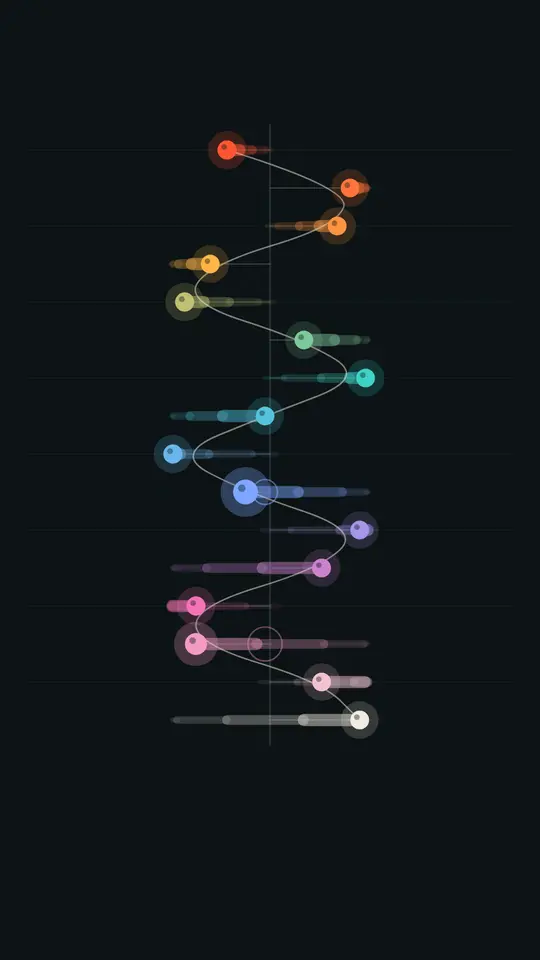
In our polyrhythm visualizer, every voice is a dot moving at constant speed and touching a baseline at regular intervals. Each hit plays a note and shows a ripple. Pick two dots and count their hits over the whole video. Their counts form a ratio. Two neighbouring voices with a gap of 1, for example 31 and 32 hits, form a ratio of 31:32, which is already in lowest terms because consecutive whole numbers are coprime.
The slowest dots tick almost like a clock while the fastest ones become a buzz. If you look at the moment of the final alignment, all the dots reach the baseline at the same time, and the final chord plays. That moment is where all the cycles finish a whole number of turns together.
Choosing numbers that sound and look good
Small ratios such as 3:2 and 4:3 are easy to follow and feel grounded. Larger coprime ratios such as 5:4, 5:7 or 7:8 feel more complex but are still readable when you hear both voices clearly, for instance with different timbres. Very large counts become a texture rather than a rhythm; the ear stops counting and hears density.
For a short video, pick a handful of voices at first, say 8, and a gap of 1 for a coherent drift, or a gap of 2 or 3 for faster, more varied patterns. Use a pentatonic scale to keep overlapping notes consonant.
Practical tips for the video
Tell the audience in the hook what to watch for: the moment when all the dots meet again. Keep the lines in the centre of the frame, avoid the top and bottom areas used by the app, and choose a duration between 20 and 40 seconds so the pattern builds up and resolves.
Change shape, gap, scale and palette between videos to avoid posting repeated clips.
Frequently asked questions
- Is 6:4 different from 3:2?
- Musically the pattern is the same, with the 3:2 cycle played twice. The two voices coincide twice instead of once per cycle.
- Why does 5:7 feel irregular?
- The least common multiple is 35, so the voices only coincide at the start of a long cycle and never in between.
- What is the difference with a polymeter?
- A polymeter keeps the pulse and changes the bar length. A polyrhythm shares the cycle and changes the pulse.