The pendulum wave explained
Why a row of pendulums forms waves and then lines up again: the period formula, how to choose lengths, and the patterns at each fraction of the cycle.
What you see
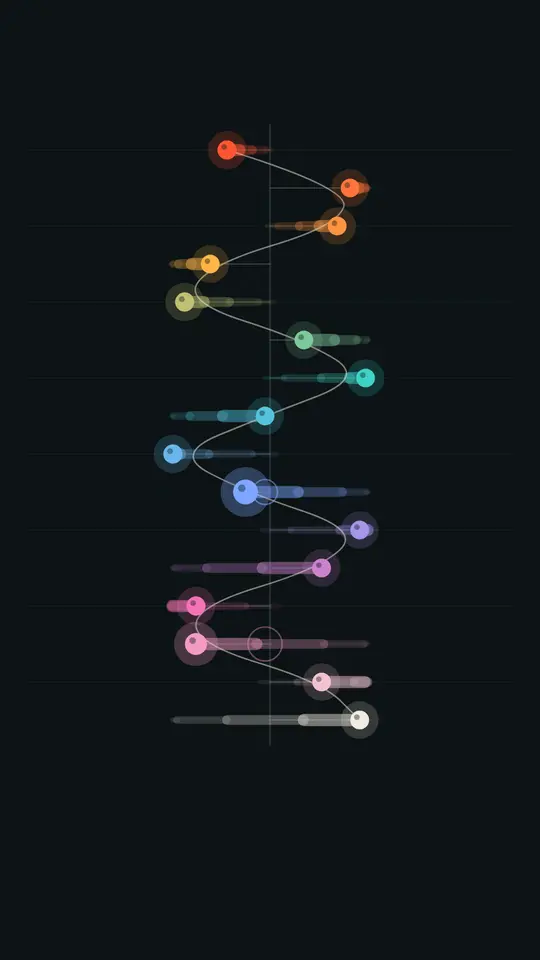
A pendulum wave is a row of pendulums of increasing length, released together. At first they swing in unison. Within seconds the row seems to ripple, the motion travels along it like a wave, the pendulums sort themselves into groups, and later they appear to move randomly. Then, at a precise moment, they line up again and the whole cycle restarts.
No pendulum is aware of the others. Each swings at its own steady rate. The wave is purely a pattern of phases, and it is a clear example of how adding simple oscillations gives complex shapes.
The period of a pendulum
For small swings, the period of a simple pendulum of length L is T = 2 pi sqrt(L / g), where g is the acceleration of gravity, about 9.8 m/s squared. Two points matter. The period does not depend on the mass of the bob, and for small angles it barely depends on the amplitude. And because of the square root, to double the period you must make the pendulum four times longer.
Rearranging gives L = g T squared / (4 pi squared). For a period of 1 second, L is about 25 cm. For 2 seconds it is about 1 metre.
Choosing the lengths so that they realign
To build the wave, you choose a total cycle time T0, for instance 60 seconds, and a first pendulum that makes N swings during that time. The next makes N + 1, the next N + 2, and so on. The period of pendulum number i is T0 / (N + i), and its length follows from the formula above. As T0 and N grow together, lengths decrease slowly and in a regular way.
After exactly T0, pendulum i has made N + i complete swings, a whole number, so it is back at its starting position and velocity, just like all the others. That is the realignment. It is not a coincidence or a chaotic accident: it is built in by choosing whole numbers of swings.
Reading the pattern at each moment
The phase of pendulum i, in turns, at time t is (N + i) t / T0. The difference in phase between neighbours is therefore t / T0 turns, the same all along the row. It grows steadily from 0 to 1 over the cycle. The patterns follow from this single number.
At t = T0 / 2, neighbours differ by half a turn: they are opposite. Every other pendulum is in step, so the row splits into two interleaved groups swinging in opposite directions. At t = T0 / 3, the difference is a third of a turn, and pendulums three places apart are in step: you see three groups. At t = T0 / 4, four groups, and so on. At a fraction such as 2/5 the same rule applies with five groups, arranged in a different order. Between these moments, the wave appears to travel, and at some fractions the alignment looks random because q is large compared with the number of pendulums on screen.
So, at any fraction p / q of the cycle (p and q without common divisor), the pendulums split into q groups and the picture repeats every q pendulums. That is why 15 to 20 pendulums give clean stripes for q up to 5 or 6.
How the generator draws it
In the tool, the number of pendulums runs from 8 to 24 and the cycle fills about 93 % of the video, which leaves a short moment at the end for the final chord. The motion of each pendulum is drawn as a harmonic oscillation with the exact period for its rank, which is the small-angle model. The amplitude setting therefore changes the look but not the timing, and the final alignment is exact.
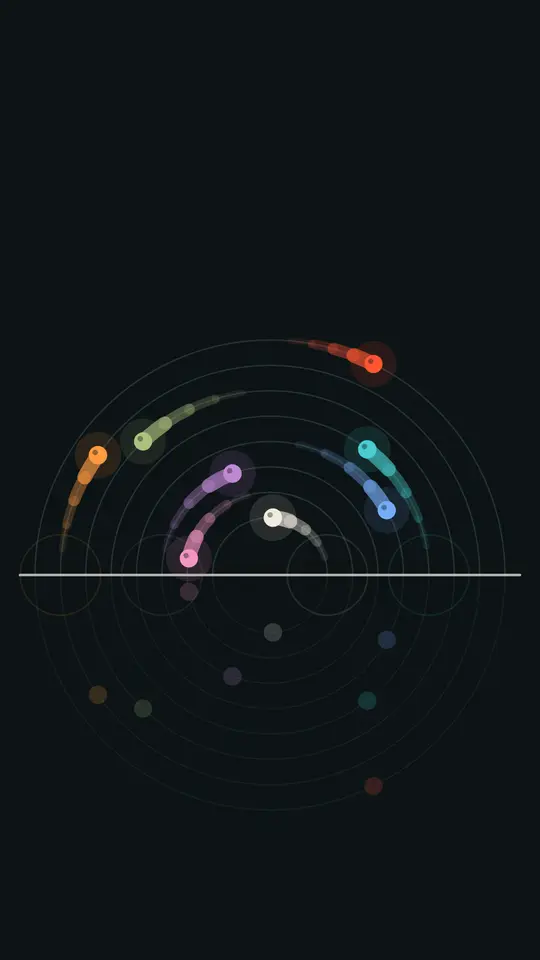
The layouts only change how the same phases are shown: a line seen from above, a fan of pendulums of different lengths, or a circle. Each pendulum plays a note each time it passes the centre of its swing.
Making a good video from it
The structure is simple: calm start, increasing complexity, apparent chaos, then resolution. Put the promise in the hook, such as asking the audience to wait for the moment they all line up. Pick a duration of 20 to 40 seconds so the waves have time to appear.
To avoid repeating yourself, vary the layout, the number of pendulums, the scale and the palette, and write a different hook each time.
Frequently asked questions
- Does the mass of the pendulum change the wave?
- No. For a simple pendulum the period depends on the length and gravity, not on the mass.
- Why is the realignment exact?
- Each pendulum completes a whole number of swings in the cycle, so all of them are back at the starting point at the same moment.
- What happens if I use larger swings?
- For large angles the period depends slightly on the amplitude, and the realignment of a real device becomes approximate. The generator uses the small-angle model, so it stays exact.